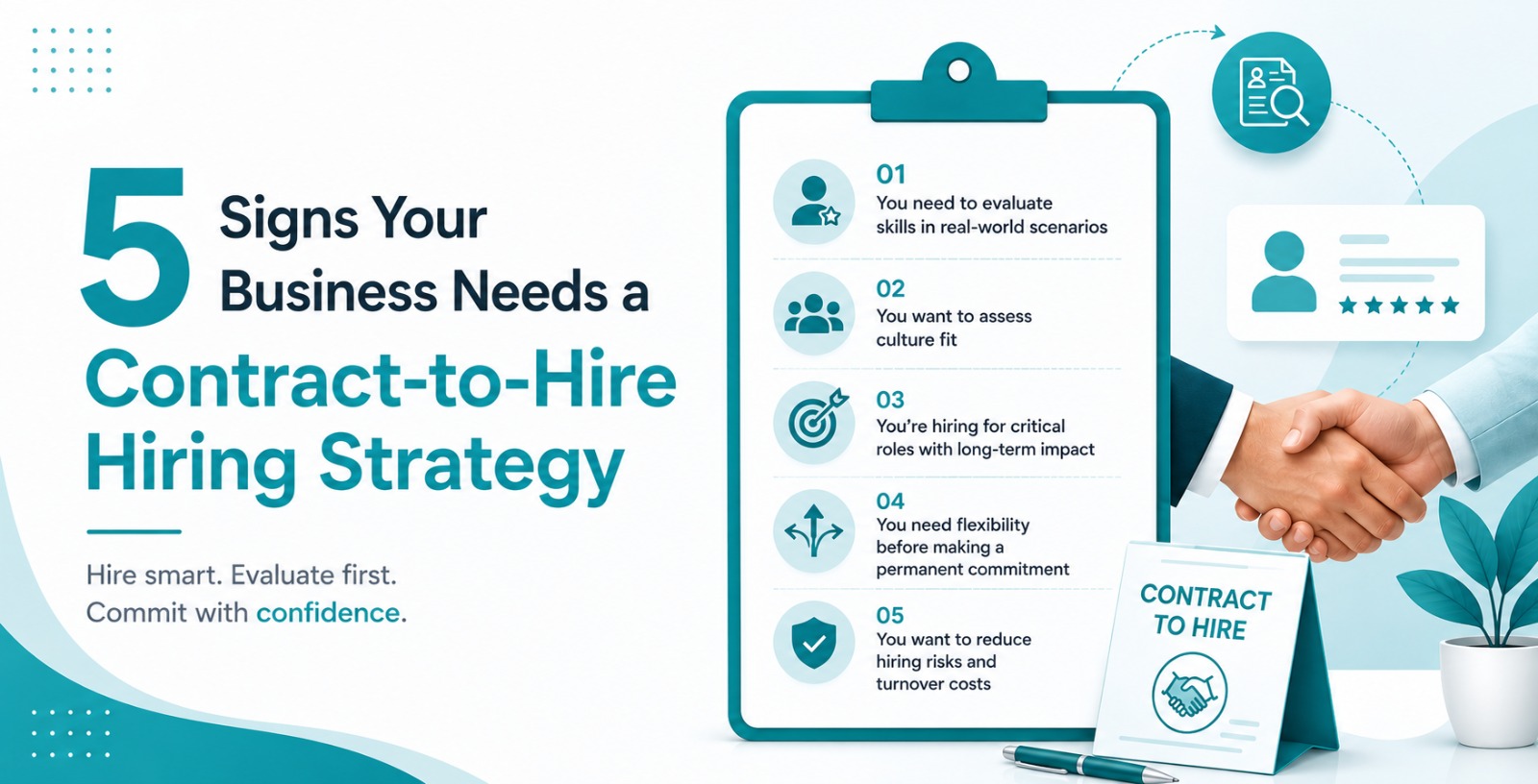
5 Signs Your Business Needs a Contract-to-Hire Hiring Strategy
Not Sure If You Should Hire Permanently?
Don’t Guess
Test the Fit
Hiring someone on a permanent basis is a big decision.
A good resume can impress you.
A good interview can convince you.
But neither can fully answer the most important question:
“Is this person really going to fit into our business?”
That’s where contract-to-hire staffing steps in to change the game.
Instead of making a long-term commitment based on interviews and resumes, companies can hire a professional on a contract basis, see how they perform in the real work environment, and then decide whether to make the relationship permanent.
So when is this hiring approach a good idea?
Here are 5 signs of business needs:-
1. You Need Talent Now – But You’re Not Ready for a Permanent Commitment
Projects don't wait on hiring decisions.
You might need a software developer, cloud engineer, cybersecurity specialist, data specialist, or another kind of IT professional to keep a project on track.
But hiring for keeps when you’re not sure of the long-term need adds unnecessary risk.
Contract-to-hire is the smarter middle ground.
You get the experience you need today, but leave the door open for permanent employment.
Talent right here. Flexible commitment.
2. The Candidate Looks Great on Paper – But You Want to Watch Them in Action
A resume tells what a person has done.
An interview shows how they communicate.
But real work tells you how they actually perform.
With a contract-to-hire arrangement, companies can assess a candidate’s:
Technical skills
Problem Solving
Communications
Efficiency
in collaboration
Flexibility
Ability to work under real project pressure
You're not just saying Can they do the job.
You're testing if they actually can.
3. Culture Fit Is Questionable
Skills will land you a job.
The key to success is fit.
Even the most technically brilliant professional will struggle if their communication style, working habits, or expectations are not in sync with the team.
A contract period allows both parties to test the working relationship before making a permanent decision.
And that’s important because culture fit is a two-way street.
The candidate is assessed by the company.
The candidate assesses the company.
4. Keep a Flexible Workforce
Business needs evolve.
A project is stalled.
A new client arrives.
Technology needs to evolve.
Or a team suddenly needs specialist expertise.
When you have a temporary or uncertain need, a permanent hire isn’t always the right answer.
Flexibility. Contract-to-hire staffing gives businesses the
It provides organizations with access to specialist talent while they work out if the role should eventually become permanent.
Hire for what is needed. Choose according to the reality of tomorrow.
5. The Price of a Bad Hire Is Too High
Bad hires aren’t just a payroll issue.
It can make a difference:
Projects, Productivity, Team Morale, Deadlines, Revenue
Firing an unsuitable employee can also mean starting the hiring process all over again.
That uncertainty can be costly in terms of critical IT roles.
Contract-to-hire does not take away the risk of hiring, but it can provide businesses with more information before making a long-term commitment.
And better information is better hiring.
What is the contract-to-hire process?
The idea is simple:
Find → Contract → Assess → Decide → Employ
01 – Find
Define the skills and experience required for the role and identify suitable candidates.
02 — Agreement
You bring the pro you have chosen into the business for a period of time you agree to.
03 — Evaluate
Assess their technical skills, communication, collaboration, and overall fit.
04 — Make a decision
Does the professional meet the long-term needs?
05 — Employ
If both sides feel it’s a good fit, move the professional into a permanent role.
Contract-to-Hire and Permanent Hiring
Permanent recruits:
“We believe you’re a good fit. “Let’s do it. "
Contract to hire:
“Let’s collaborate, test the fit, and then make a decision.”
Neither is better or worse than the other.
If the need, role, and candidate fit are already clear, it may make sense to go permanent.
However, if you’re uncertain about skills, culture fit, workload, or long-term needs, contract-to-hire recruiting offers valuable flexibility.
The Real Advantage
Make Better Decisions.
The biggest advantage of contract-to-hire is flexibility.
No, it's confidence.
It enables businesses to collect real-world evidence rather than make a permanent hiring decision based on limited information.
You can see that:
How they operate.
How they work together.
How They Fix Problems.
What they may do.
How do they fit?
Then you make your choice.
But the fastest isn’t always the best hiring decision. It's the one you can do with confidence.
Conclusion
If you have a critical IT hiring need, an uncertain long-term requirement or just want to mitigate the risk of a bad hire, contract-to-hire staffing can be a practical alternative.
It opens up talent for businesses today, while making space to assess tomorrow.”
Don't hire people for their potential. See the potential at work.
The right contract-to-hire hiring strategy allows businesses to turn uncertainty into insight—and insight into better long-term hiring decisions.